

7 Mistakes You’re Making with Answer Engine Optimization (And How to Recover Your CTR)

Click-through rates are falling on pages that rank well, load fast, and have never triggered a manual penalty. The content is solid. The technical foundation is clean. And yet traffic keeps eroding — quietly, consistently, in a pattern that traditional SEO audits never flag. The AEO mistakes driving that erosion are specific, repeatable, and fixable — but only once teams stop looking for the cause in the wrong place.
What is happening is straightforward: answer engines intercept the session before the user reaches the results. Google AI Overviews, Perplexity, and ChatGPT synthesize a response, the user gets what they came for, and nobody clicks. The content is not the problem. The problem is that it was built for a search environment that no longer fully applies.
Most agencies have identified this shift. Fewer have changed how they work in response to it. Here are the seven AEO mistakes that explain the gap — and what answer engine optimization actually requires instead.
AEO Mistake 1: Assuming It Is Traditional SEO With Better Keywords
Traditional SEO is built on signals — keyword frequency, backlink authority, technical compliance. Those signals tell an algorithm which pages to surface. Answer engine optimization works differently. Generative models do not rank pages. They synthesize answers from sources they determine to be trustworthy, clearly structured, and specific enough to cite with confidence.
A page optimized for keyword density but vague on substance gives a language model nothing useful to extract. The model already contains a version of that information. Without something more specific — a clearer explanation, a defined entity, a direct answer — there is no reason to cite the source. According to Google’s documentation on AI Overviews, content surfaces in AI-generated answers when it demonstrates genuine expertise — not when it matches a keyword pattern.
The shift required is from optimizing for queries to optimizing for questions. Covering the full context of a user’s problem — the relationships between concepts, the nuances, the specific scenarios — gives a model enough to work with.
Mistake 2: Treating Schema as a Rich Snippet Tactic
Structured data has been optional for years. Agencies implemented it when clients wanted rich snippets and skipped it when they didn’t. That calculation no longer holds.
Schema markup communicates page structure to a language model in a format it can parse immediately. FAQPage schema tells the model which content is a question and which is the answer. Article schema establishes authorship and publication context. HowTo schema sequences steps the model can follow and reproduce. Without those signals, the model has to infer — and it consistently prioritizes sources that make inference unnecessary.
This particular AEO mistake is not just about missing schema. It is implementing schema with errors and assuming it works. A malformed FAQPage JSON block adds noise, not signal. Verifying that structured data is present, correctly implemented, and comprehensive is a prerequisite for answer engine visibility — not a finishing touch.
Mistake 3: Writing for Dwell Time Instead of Direct Answers
Long-form content built around keeping users on the page longer made sense when time-on-page correlated with ranking signals. In answer engine optimization, that structure works against visibility.
Generative models extract the most direct, concise answer available. A 2,500-word article where the answer appears in the third section loses to a shorter article that leads with it immediately. The model does not reward the build-up. It finds the answer, extracts it, and moves on. If that answer is easier to find on a competitor’s page, the competitor earns the citation.
Restructuring content around the inverted pyramid — direct answer first, supporting context after — serves both the model and the reader. It is also a genuine differentiator, because most long-form content still buries the lead.
Mistake 4: Scaling Content Without Differentiation
Generic content published at volume was viable when algorithms rewarded freshness and coverage. Generative models assess it differently. They do not cite sources that restate what the model already knows. A page summarizing widely available information gives a language model no incentive to attribute it to a specific source — the model already contains a version of that summary.
What earns citations is content the model cannot synthesize from existing training data — proprietary data, original research, specific case examples, firsthand experience, expert analysis beyond the consensus view. The Search Console performance data inside a unified reporting platform identifies which pages already gain traction in AI results. That data makes it easier to understand what differentiates them and apply the same approach elsewhere.
Mistake 5: Targeting Fragments Instead of Conversations
Traditional search queries are short and fragmented. “SEO audit tool.” “Agency reporting software.” Answer engine queries are conversational and specific. “What is the most efficient way to automate monthly SEO reporting for a 20-client agency?” These two query types attract different users at different stages.
Conversational queries come from users who have done preliminary research and want something specific. They convert at higher rates and generate more qualified traffic. This is one of the less obvious AEO mistakes — teams focus on volume of queries targeted rather than the intent quality of the queries they are missing.
Restructuring headers as full questions aligns content with how answer engines process queries. An H2 reading “How Does Automated Reporting Reduce Agency Overhead?” gives a model more to work with than “Reporting Features.” It also signals to the reader that the page addresses their specific question rather than a general topic.
Mistake 6: Measuring Rank Without Measuring Citations
Position one in traditional search and zero presence in AI-generated answers can coexist on the same page for the same query. Most rank trackers only show the former. The CTR impact of AI Overviews intercepting sessions above organic results is real, measurable, and invisible to tools not built to track it.
Agencies diagnosing CTR decline accurately track citation rates alongside rankings. They monitor how often content appears as a cited source in ChatGPT, Perplexity, and Google AI Overviews for commercially important queries. Without that layer, the connection between AI answer prevalence and click erosion stays a hypothesis. The AEO and GEO audit makes that connection visible alongside the rest of the site’s performance data.
Mistake 7: Auditing Performance Instead of Monitoring It
Answer engines prioritize fast, stable sources. When an AI crawler encounters a slow page, it moves to the next available source on the same topic. A competitor loading in under two seconds earns the citation. A client loading in four seconds does not — regardless of content quality or entity clarity.
Treating performance as a periodic exercise rather than a continuous discipline is one of the most costly AEO mistakes in practice. Most agencies treat Core Web Vitals as a quarterly audit item. A three-day performance regression from a plugin update or uncompressed images may never appear in a monthly report. However, it can give an AI crawler enough reason to prefer a different source — and that preference can persist long after the underlying issue is fixed. Continuous Core Web Vitals monitoring catches those windows before they cost citations rather than after.
What These AEO Mistakes Have in Common
None of these are obscure technical failures. They are the predictable result of applying a traditional SEO framework to a search environment that runs on different logic. Traditional SEO optimizes for algorithm signals. Answer engine optimization optimizes for model trust — earned through entity clarity, content specificity, structural accessibility, and technical reliability.
The CTR erosion on high-ranking informational pages is not a mystery. It is a legible signal that the content foundation was designed for a search environment that has changed. The agencies recovering that traffic are rebuilding for the environment that exists now — not continuing to optimize the surface of a strategy built for the one that came before.
Related Articles
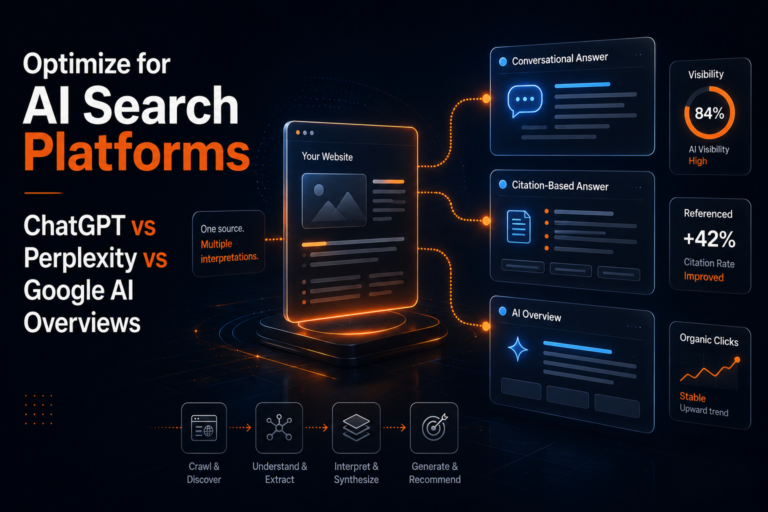
Optimize for AI Search Platforms: ChatGPT vs Perplexity vs Google AI Overviews
Most agencies still optimize for one set of rules. Meanwhile, their clients get cited across AI search platforms...
Do You Really Need Answer Engine Optimization? The Truth for Digital Agencies
The crawl data is clean. The issues are documented. The report has been delivered. And yet, your client’s...
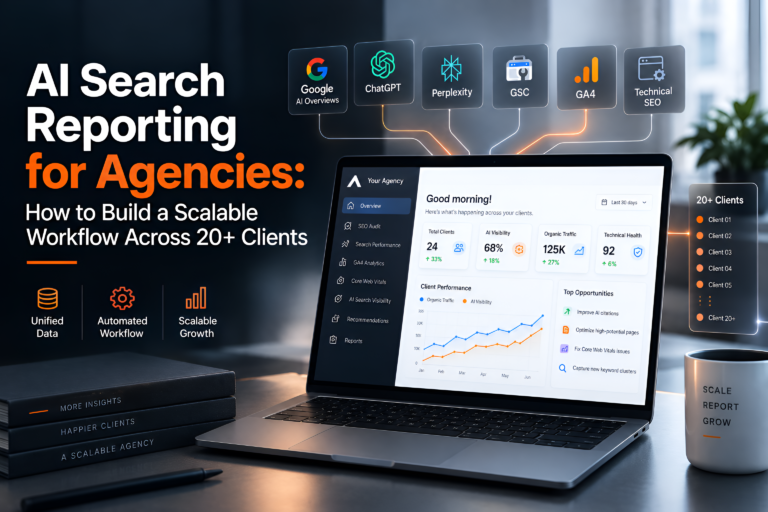
AI Search Reporting for Agencies: How to Build a Scalable Workflow Across 20+ Clients
Most agencies do not have an AI search reporting problem because they lack access to data. They have...
Ready to unify your agency's SEO stack?
Stop juggling 5+ tools for one report. Zensor brings SEO audits, GA4 analytics, GSC data, and AI search tracking into a single platform.