Most agencies shopping for a white label SEO report focus on the wrong things. They compare pricing tiers, check if their logo fits in the header, and run a quick demo. Three months later, however, they are paying per-client surcharges they never anticipated. Reports still require manual cleanup before every delivery. A tool sold as automated still demands two hours of work per client.
The white label SEO report market is crowded. Many products look identical in a sales deck but behave very differently in production. The ten points below separate tools that serve agency operations from ones that simply relocate the problems.
1. True White Labeling Goes Beyond the Logo
Most tools claim white label capability. In practice, many deliver logo placement and little else. The agency name sits in the header. The vendor’s infrastructure is everywhere else. Clients receive emails from a vendor domain. Login URLs point to a third-party portal. The favicon reveals the platform the moment a client opens the tab.
In practice, true white labeling means the vendor is completely invisible. The login URL belongs to the agency. Emails arrive from the agency’s domain. Consequently, the client experience contains nothing that suggests the agency is reselling a third-party product. The login, the emails, and the reports all belong to the agency. That distinction matters more as clients become more technically aware and as agency differentiation becomes harder to sustain.
2. Per-Client Surcharges Are a Growth Tax
The pricing model most agencies encounter looks straightforward: a monthly base fee with a per-client charge on top. The problem becomes visible at scale. At five clients, the math works. At thirty clients, however, the software bill compresses margins on every new account the agency wins.
A white label SEO report platform built without per-client surcharges changes that calculation entirely. Growth stops being taxed at the reporting layer. Moreover, the cost of onboarding a new client stays flat regardless of how many are already on the platform. That is how software for scaling businesses should work.
3. Fragmented Data Produces Fragmented Insight
The standard agency tool stack involves at least four platforms. One handles technical audits, one handles Search Console data, one covers GA4 traffic, and something separate tracks rank positions. Each tool produces its own output. Furthermore, someone — usually the most experienced person on the team — assembles those outputs into a coherent narrative before every client delivery.
That assembly step is where insight gets lost and time gets wasted. When audit findings, traffic data, and search performance live in separate systems, connecting a technical issue to its traffic impact requires manual inference. As a result, that step takes time and introduces error. A unified platform removes that step. As discussed in why SEO recommendations die in the development backlog, fragmented data is one of the most consistent reasons good analysis never translates into action.
4. AI Search Visibility Is No Longer Optional in a White Label SEO Report
A white label SEO report that tracks keyword rankings but ignores AI search visibility is incomplete. In practice, it reports on roughly half of what drives search performance in 2026. Google AI Overviews, Perplexity, and ChatGPT intercept sessions on informational queries before users reach organic results. As a result, citation rates in AI-generated answers have become a meaningful traffic variable.
According to Google’s documentation on AI Overviews, content that surfaces in AI-generated answers meets a higher standard of expertise and structure than content that simply ranks well. Tracking whether clients meet that standard is what separates current reporting from reporting built for 2020. Knowing where they fall short is how agencies act on it. The AEO and GEO audit layer makes that tracking possible within the same environment as the rest of the site’s data.
5. Core Web Vitals Require Monitoring, Not Auditing
Performance metrics fluctuate constantly. A plugin update, a new image batch, or a server configuration change can shift LCP, INP, or CLS scores significantly between reporting periods. A tool that checks Core Web Vitals once a month, therefore, misses everything that happens in between.
Instead, real-time Core Web Vitals monitoring integrated directly into the reporting workflow means performance regressions surface when they happen. For agencies managing sites with frequent technical changes, that difference matters. Catching a problem early is considerably less costly than explaining a traffic drop after the fact.
6. AI Recommendations Should Replace Data Dumps
A 50-page PDF of flagged issues is not a deliverable. It is a transfer of anxiety from the agency to the client. Clients do not pay agencies to identify problems. Instead, they pay agencies to explain which problems matter, in what order to address them, and what the expected outcome looks like.
In practice, a platform with genuine AI-powered prioritization does that translation automatically. Rather than listing every broken link and missing alt tag with equal weight, it sequences issues by impact. Only what matters most reaches the top. The output shifts from a data dump to a roadmap — which is what clients need to make decisions and take action.
7. Live Dashboards Have Replaced Monthly PDFs
Static reports are outdated the moment they are generated. A client who receives a PDF on the first of the month cannot check progress on the fifteenth without contacting the account manager. That friction creates unnecessary touchpoints and positions the agency as a gatekeeper to information the client is paying for.
However, live, branded client portals change that dynamic. Clients check progress on their own timeline, without requiring agency involvement. As a result, fewer reactive emails arrive. Conversations shift toward strategy. The client relationship feels more like a partnership than a monthly subscription to a document.
8. Search Console Analysis Should Go Deeper Than Total Clicks
Native Google Search Console is useful but limited for client-facing reporting. Total clicks and average position tell part of the story. Branded versus non-branded query splits, period-over-period comparisons, device breakdowns, and query opportunity analysis tell the rest. Most white label reporting tools, however, pull the surface-level GSC data and stop there.
In contrast, deeper Search Console analysis shows clients exactly which non-branded queries drive growth and which opportunities remain uncaptured. It also gives account managers specific talking points that justify continued SEO investment rather than generic performance summaries.
9. One-Click Automation That Actually Works
Automation is one of the most overused words in the SEO platform market. Most tools that claim to automate reporting still require manual intervention before the output is client-ready. Formatting adjustments, data corrections, narrative additions — the “automated” report becomes a starting point rather than a finished product.
In contrast, genuine automation means the report is complete without manual editing. It pulls the audit data, traffic data, search performance, and AI visibility metrics into a branded document in one step. Furthermore, the time recovered from that process redirects toward strategy, client communication, and the work that actually differentiates the agency from its competitors.
10. Tool Consolidation Has a Real ROI
The fragmented tool stack most agencies run compounds in cost and in complexity. Separate platforms for audits, rank tracking, reporting, Core Web Vitals monitoring, and AI visibility each add their own overhead. Furthermore, each additional tool adds a billing relationship, a login, a data export workflow, and a gap between systems where information gets misaligned.
Consolidating that stack into a single platform reduces monthly software spend and eliminates the gaps between data sources. Moreover, it removes the manual work that currently fills those gaps. Savings show up in two places. First, the monthly software bill drops. Second, hours recovered from report assembly return to higher-value work.
The Real Question When Evaluating a White Label SEO Report Platform
The ten points above share a common thread. In short, platforms built around how agencies actually operate remove friction. General SEO tools with a white label skin applied afterward simply relocate it.
The first type removes friction. Reports go out faster, clients understand them more clearly, and the data supports the strategic conversations that justify the agency’s fees. The second type relocates friction — shifting it from one part of the workflow to another — without reducing the total work required.
That distinction is worth spending time on before signing a software contract. It is considerably easier to evaluate during a trial than to discover three months into a commitment.

Related Articles

SEO Reporting: How Agencies Turn SEO Data Into Clear, Actionable Insights
SEO reporting is one of the most misunderstood parts of search engine optimization. Most agencies produce reports. Very...
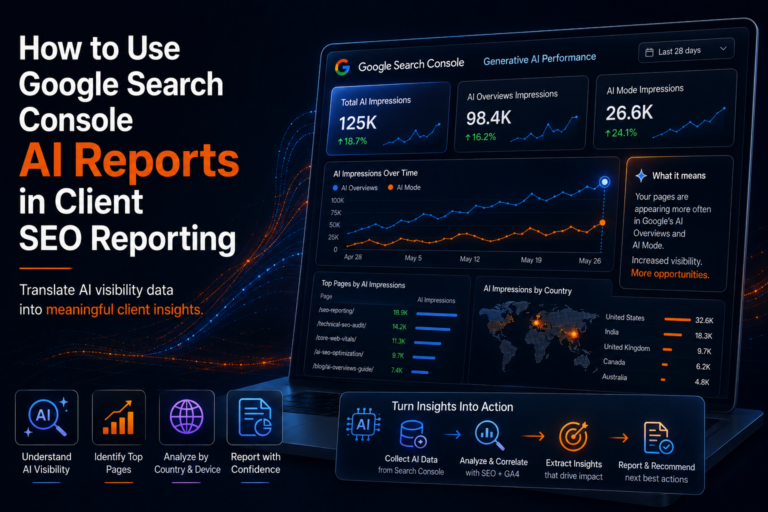
How to Use Google Search Console AI Reports in Client SEO Reporting
Google Search Console now includes a dedicated generative AI performance report for eligible properties. It shows how often...
AI-Driven SEO Workflows: How Agencies Should Adapt Their Teams
AI is changing how SEO work gets done — but not in the way most agencies expect. Tasks...
Ready to unify your agency's SEO stack?
Stop juggling 5+ tools for one report. Zensor brings SEO audits, GA4 analytics, GSC data, and AI search tracking into a single platform.