
GEO fundamentals have a noise problem. Since AI search became a mainstream concern for agencies, the conversation has been dominated by shortcuts — prompt engineering tricks, mass AI content strategies, and techniques that promise to “hack” visibility in ChatGPT or Google AI Overviews. Most of them fail within weeks. The ones that don’t fail immediately cause more damage than doing nothing at all.
GEO is not a hack. It is the most rigorous form of SEO that has ever existed — because the systems it tries to influence are harder to deceive than any algorithm Google has deployed.

Why AI Search Cannot Be Gamed
The shortcuts that defined early SEO — keyword stuffing, link schemes, thin content at scale — worked because search algorithms were pattern matchers. Feed them the right patterns and they responded predictably. The SEO industry built entire businesses on that predictability.
Generative engines work differently. Models like ChatGPT, Perplexity, and Gemini do not rank pages. They synthesize answers from sources they determine to be authoritative, accurate, and clearly structured. The selection criteria are not based on keyword frequency or link anchor text. Instead, they assess whether the content demonstrates genuine expertise, whether the entity behind it is well-defined, and whether the information can be extracted and cited with confidence.
A site full of thin AI-generated content does not confuse these models. It simply gets ignored. There is no penalty equivalent — the content just never gets cited. And because citation rates are harder to monitor than keyword rankings, many agencies do not realize the problem exists until the traffic data makes it impossible to ignore. According to Google’s own guidance on helpful content, AI systems prioritize content that demonstrates first-hand expertise and clear topical authority — exactly what shortcuts cannot produce.
What GEO Fundamentals Actually Require
GEO fundamentals sit on top of technical SEO — they do not replace it. Any agency trying to improve a client’s AI search visibility without first addressing the technical foundation builds on unstable ground. An AI crawler like GPTBot operates under the same constraints as any other crawler. If a site is slow, structurally broken, or difficult to parse, the crawler moves on. No amount of content optimization compensates for that.
Beyond the technical foundation, solid GEO fundamentals require three things that traditional SEO has always valued in theory but rarely had to deliver with precision.
Semantic Clarity and Entity Definition
Generative models are entity-driven. They process pages as statements about entities and the relationships between them — not as collections of keywords. A page that clearly defines what an organization does, who it serves, and why it is authoritative on a specific topic gives a language model something to work with. A page that gestures vaguely at a topic without clear, extractable statements gives the model nothing worth citing.
Schema markup, clear header hierarchies, concise factual definitions, and structured Q&A content are no longer optional for sites that want AI visibility. If a model cannot summarize a page in two or three sentences with confidence, that page will not be cited. The AEO and GEO audit layer exists specifically to identify where that clarity is missing across a site at scale.
Technical Health as a GEO Fundamentals Signal
Core Web Vitals have always mattered for search. In the context of AI search, they matter for a different reason. When an AI crawler encounters a slow or unstable page, it does not wait — it moves to the next available source for the same information. If a competitor’s page on the same topic loads faster and is more clearly structured, that competitor earns the citation. The client does not.
Real-time monitoring of Core Web Vitals — rather than a monthly check-in — is the only reliable way to ensure technical performance does not silently undermine AI visibility. A performance drop lasting three days may never appear in a monthly report, but it may give an AI crawler enough reason to establish a preference for a different source.
Unified Data Instead of Fragmented Tool Stacks
A GEO strategy built on disconnected tools is not a strategy. It is a collection of observations with no coherent thread connecting them. Traditional SEO tools report rankings. GEO requires visibility tracking — specifically, how often a brand gets cited in ChatGPT responses, how frequently it appears in Google AI Overviews, and how those citation patterns correlate with actual GA4 traffic. Without those data points in a single view, decisions about what to optimize and in what order become guesswork.
This is why integrating AI tools into a unified analytics workflow has become a structural requirement rather than a nice-to-have for agencies serious about AI search performance.
The Cost of Chasing Shortcuts
Agencies that spent 2024 and 2025 scaling AI content at volume now deal with the consequences. Not because Google penalized them in the traditional sense, but because their content has no presence in AI-generated answers. The models assessed it, found nothing worth citing, and moved on. Rebuilding that foundation takes considerably longer than building it correctly from the start would have.
For client-facing agencies, the risk compounds further. When a client loses a significant share of their AI Overview visibility, the conversation about why is not easy. Explaining that the strategy relied on shortcuts that ignored how generative engines evaluate content is a difficult conversation — and an avoidable one.
Depth Wins Where Speed Cannot
The shift that strong GEO fundamentals demand is not primarily technical. It is strategic. The question is no longer how quickly content can be produced — it is how thoroughly a topic gets covered, how clearly an entity gets defined, and how consistently a site demonstrates expertise that a generative model would trust enough to cite.
That is a higher bar than traditional SEO set. It is also a more defensible position. A site that earns AI citations through genuine topical authority, strong technical health, and clear entity definition is considerably harder to displace than one that earned traditional rankings through volume and link velocity.
The agencies building toward that standard are not chasing the next AI hack. They are doing the foundational work that has always separated sustainable SEO from short-term gains — and finding that the AI era rewards it more reliably than any era that came before.

Related Articles
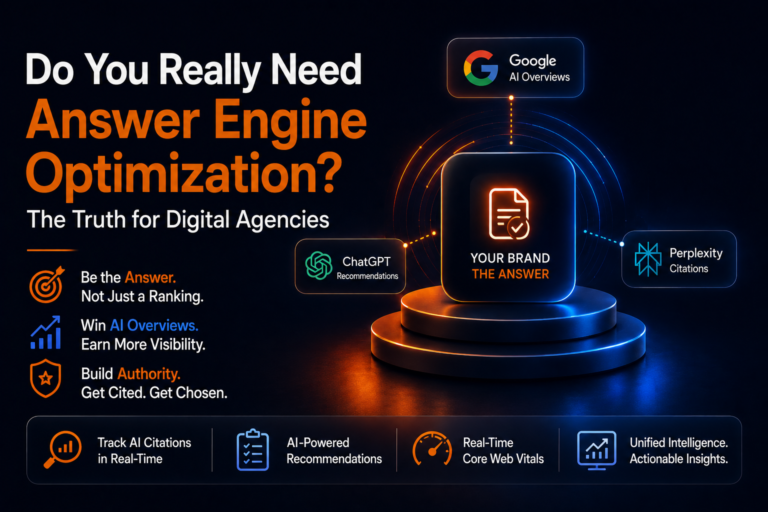
Do You Really Need Answer Engine Optimization? The Truth for Digital Agencies
The crawl data is clean. The issues are documented. The report has been delivered. And yet, your client’s...

Turning SEO Data into Action: AI-Generated Client-Friendly Reports
SEO today generates more data than ever before—rankings, traffic trends, crawl errors, Core Web Vitals, backlinks, conversions, and...

AI SEO Tools: 8 Ways Agencies Can Use Them Without Losing Strategic Control
AI SEO tools have a deployment problem. Agencies adopt them, output increases, and then something quietly breaks: the...
Ready to unify your agency's SEO stack?
Stop juggling 5+ tools for one report. Zensor brings SEO audits, GA4 analytics, GSC data, and AI search tracking into a single platform.