
Every agency reaches a point where the tools start working against them. The reports carry someone else’s logo. The software bill climbs with every new client. The team spends more time assembling data than acting on it. For most agencies, a white label SEO dashboard is the operational fix they delay until the problem becomes expensive. The agencies that treat it as infrastructure from the start are the ones that scale without the friction that stops most at 20 clients.
It is often framed as a branding decision. In practice, it is an operational one. The difference between those two framings determines how seriously it gets prioritized.
The Problem With Reporting Under Someone Else’s Brand
When a client receives a report with a third-party tool’s logo in the header, something subtle happens. The tool becomes part of the conversation. Clients start asking about it. Some start wondering whether they could buy it directly and cut out the agency. Others simply register — consciously or not — that the intelligence they are receiving is not proprietary to the team they hired.
None of that serves the agency.
Removing the tool from the equation entirely changes the dynamic. What remains is the agency’s analysis, the agency’s recommendations, and the agency’s brand. The platform becomes invisible infrastructure, and the agency becomes the intelligence layer. That is a meaningfully different relationship than vendor reselling. You can see exactly what that looks like in practice on the Zensor white-label reporting page.
Why Clients Care More Than You Think
The assumption most agencies make is that clients don’t notice the reporting tools. Some don’t. But the ones who do tend to be the clients with the largest budgets and the most options.
Professional presentation signals operational maturity. A dashboard that carries the agency’s brand, uses consistent visual language, and surfaces only the metrics relevant to that client’s goals reads as built specifically for them — even when it wasn’t. That perception matters in retention conversations, in referral quality, and in the justification of premium pricing.
Clients rarely renew contracts because of technical SEO findings. They renew because the agency feels indispensable. A branded reporting experience is one of the lowest-effort ways to reinforce that perception every single month.
Why a White Label SEO Dashboard Changes Your Scaling Economics
Traditional SEO tools are built around a per-client or per-site billing structure. Sign a new client and the software bill goes up. Manage fifty websites and the overhead compounds in ways that were not visible when you were managing ten. The result is a business model that punishes growth — where the reward for acquiring new clients is higher fixed costs rather than higher margins.
Most agencies absorb this quietly and build it into their pricing. What they rarely do is question whether the structure itself is the problem. A white label SEO dashboard built without per-client surcharges changes the unit economics entirely. The cost of adding a client becomes effectively zero at the reporting layer, which means growth becomes something the platform enables rather than something it taxes.
What Most Reports Get Wrong
The standard approach to client reporting is the data dump. A 40-page PDF arrives containing every metric the platform can export, colour-coded by severity, with hundreds of flagged issues and no clear indication of where to start. The client either panics or ignores it. Neither outcome moves the work forward.
The problem is not the volume of data. The problem is the absence of judgment. A report that tells a client their site has 200 errors is a diagnostic. A report that tells a client which three fixes will have the most impact on their organic traffic this quarter is a recommendation. One creates anxiety. The other creates action.
Real professionalism in reporting is not about how much data you can surface. It is about how much you can filter, contextualize, and prioritize before the client ever opens the document. As discussed in why SEO recommendations die in the development backlog, the gap between identifying an issue and actually fixing it is almost always a prioritization failure — not a data failure.
The Gap Between Seeing an Issue and Fixing It
Fragmented reporting creates a specific kind of organizational paralysis. When the audit lives in one tool, the traffic data lives in another, the Search Console performance lives in a third, and AI search visibility exists only in a manually maintained spreadsheet, the distance between insight and action becomes enormous. Someone has to assemble the picture before anyone can respond to it — and that someone is usually the most experienced person on the team.
Consolidating into a single platform that combines technical SEO audits, GA4 traffic data, Search Console performance, and AEO and GEO visibility does not just save time. It eliminates the translation layer that slows implementation down. The client — or their developer — can see the technical issue, the traffic impact, and the recommended fix in a single view. That is the difference between a report that generates a conversation and a report that generates a ticket.
The Shift From Technician to Consultant
There is a version of agency work where the team’s primary output is data collection. Crawl the site, pull the numbers, assemble the report, deliver it on the first of the month. That work has value, but it is replaceable. Any tool can produce a list of errors. Any freelancer with an SEO subscription can deliver a technical audit.
The agencies that retain clients for years — and command premium fees — are the ones that deliver interpretation alongside data. They tell the client not just what is broken but why it matters, what it is costing them, and in what order it should be fixed. They use AI-powered reporting to compress the time between data collection and strategic recommendation, and they present it all under their own brand so the client’s loyalty stays with the agency rather than the tool.
That shift — from technician to consultant — is not primarily a skills decision. It is an operational one. It happens when the reporting infrastructure supports it.
What Agencies Actually Get Back
The practical return on a properly implemented white label SEO dashboard shows up in two places: time and retention.
On the time side, the hours recovered from manual report assembly are real and significant. Those hours do not disappear — they redirect toward strategy, toward client relationships, toward the work that actually differentiates the agency in competitive pitches. An account manager spending four hours a month on report assembly and two hours on strategy is operating in the wrong ratio. A unified dashboard inverts that.
On the retention side, the effect is harder to measure but consistently observed among agencies that make the switch. Clients who receive clear, branded, prioritized reporting tend to stay longer — not because the SEO results are necessarily better, but because the experience of working with the agency feels more coherent, more professional, and more difficult to replicate elsewhere. This is one reason integrating AI tools into your analytics workflow has become a priority for agencies focused on retention rather than just acquisition.
Stop Giving Away Your Authority to Your Tool Stack
The tools an agency uses should be invisible to clients. The analysis those tools produce should carry the agency’s name, the agency’s visual identity, and the agency’s strategic judgment. When that is not the case — when clients can see exactly which platforms are being used and could theoretically replicate the workflow themselves — the agency’s value proposition becomes harder to defend.
A white label SEO dashboard is not a cosmetic upgrade. It is a structural decision about where authority lives in the client relationship. The agencies that treat it as infrastructure — rather than an optional feature — are the ones that grow without the reporting overhead that keeps most agencies stuck at the same client count year after year.
The question is not whether your clients care about how their reports look. The question is whether your reporting infrastructure is helping you build an agency or just helping you service one.

Related Articles
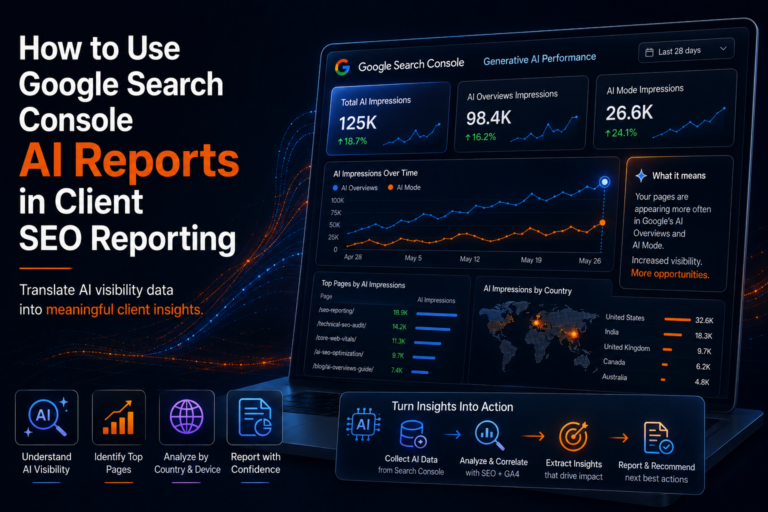
How to Use Google Search Console AI Reports in Client SEO Reporting
Google Search Console now includes a dedicated generative AI performance report for eligible properties. It shows how often...

Using AI for Efficient Client Reporting in SEO
Using AI for Efficient Client Reporting in SEO Client reporting has always been a critical part of SEO...

Predictive Analytics in SEO: Forecasting Trends with AI
SEO has always rewarded those who act early. But as competition intensifies and search ecosystems become more volatile,...
Ready to unify your agency's SEO stack?
Stop juggling 5+ tools for one report. Zensor brings SEO audits, GA4 analytics, GSC data, and AI search tracking into a single platform.