AI-powered SEO reporting is changing how agencies manage one of the most time-consuming parts of their workflow. As reporting demands increase, agencies are looking for ways to process more data, identify meaningful insights faster, and deliver clearer reporting without increasing manual effort.
Between Google Analytics, Google Search Console, technical audits, rank tracking platforms, and client-specific KPIs, SEO teams are expected to process large volumes of information every month and turn it into something meaningful.
The challenge isn’t collecting the data. The challenge is identifying what matters, understanding why it matters, and communicating it clearly to clients. This is why AI SEO reporting for agencies is becoming an increasingly important part of modern reporting workflows.
Most agencies don’t have a reporting problem because they lack data. They have a reporting problem because they have too much of it.
Rather than acting as another reporting tool, AI is helping agencies reduce manual analysis, identify patterns faster, and spend more time on strategic conversations with clients.
For agencies managing multiple clients, AI SEO reporting helps reduce manual analysis while improving consistency across reporting workflows.
Why AI SEO Reporting Matters as Agencies Scale
Most agencies start with a reporting process that works reasonably well.
Data is collected from various platforms, key metrics are reviewed, insights are added manually, and reports are delivered to clients.
As client portfolios grow, however, that process becomes harder to maintain.
Reporting begins to consume more time. Teams spend hours reviewing metrics, validating findings, identifying anomalies, and writing summaries. Senior strategists often become bottlenecks because they are the people expected to interpret the data and explain what happened.
At some point, the issue is no longer access to information. The issue becomes capacity.
Agencies need a way to process increasing amounts of SEO data without increasing reporting workload at the same pace.
How AI SEO Reporting Helps Agencies Find Insights Faster
One of the biggest advantages of AI-powered reporting is its ability to process large datasets quickly and identify patterns that would otherwise require manual investigation.
Instead of spending time comparing spreadsheets, reviewing multiple dashboards, and searching for possible explanations, teams can focus their attention on the insights that matter most.
For example, if organic traffic drops unexpectedly, an SEO specialist traditionally needs to investigate multiple potential causes.
- Were rankings affected?
- Did key pages lose visibility?
- Was there a technical issue?
- Did search demand change?
- Did a website deployment introduce new problems?
AI can help surface correlations and highlight likely causes much faster, reducing the time required to move from observation to investigation.
The goal isn’t to replace analysis. The goal is to reduce the amount of time spent finding where analysis should begin.
From Reporting Metrics to Explaining Performance
Many SEO reports still focus heavily on metrics.
Traffic increased. Rankings improved. Click-through rates changed. Technical issues were fixed.
While those metrics are important, clients are usually interested in a different question:
What does this mean for the business?
AI is helping agencies bridge that gap by adding context around performance changes.
Instead of simply highlighting that traffic declined, reporting systems can help identify contributing factors, connect related events, and generate explanations that provide a clearer picture of what happened.
This makes reporting more useful because it shifts the conversation away from reporting numbers and toward understanding outcomes.
Making SEO Reports Easier for Clients to Understand
One of the most common agency challenges has nothing to do with SEO itself.
It’s communication.
Clients often receive reports filled with metrics, charts, and technical terminology but still leave meetings unsure about what actually changed.
AI can help simplify reporting by converting technical findings into structured summaries that are easier to understand.
Rather than presenting a list of disconnected metrics, agencies can provide reports that explain:
- What changed during the reporting period
- Why those changes occurred
- Which issues require attention
- What actions are recommended next
This creates more productive conversations and helps clients connect SEO activities with measurable outcomes.
Improving the Prioritization of SEO Recommendations
Every SEO professional has encountered reports containing dozens of recommendations.
The problem is that not all recommendations deserve the same level of attention.
Some issues may affect hundreds of pages and have a direct impact on visibility. Others may be technically correct but unlikely to influence performance in a meaningful way.
AI can assist with prioritization by evaluating issue patterns, severity levels, and historical performance data simultaneously.
This helps teams focus on the recommendations that are most likely to influence results.
A major advantage of AI SEO reporting is its ability to help agencies prioritize recommendations based on likely impact rather than simply generating larger issue lists.
That approach aligns closely with modern technical SEO audits, where understanding business impact is often more important than identifying additional issues.
AI SEO Reporting Supports Agency Growth
As agencies grow, reporting quality often becomes difficult to maintain consistently across all accounts.
Different team members may interpret data differently, reporting formats may vary, and insight quality can fluctuate depending on who prepared the report.
AI helps create more consistency across reporting workflows.
As client portfolios expand, AI SEO reporting becomes increasingly valuable because it allows agencies to maintain reporting quality without proportionally increasing reporting effort.
By standardizing analysis and supporting the interpretation process, agencies can maintain reporting quality even as client numbers increase.
This is particularly valuable for agencies delivering white-label SEO reports where consistency, accuracy, and presentation quality directly affect client experience.
Moving From Reactive Reporting to Ongoing Monitoring
Traditional reporting is often retrospective.
Teams review what happened during the previous month and then communicate those findings to clients.
While that process remains important, it doesn’t always help agencies identify problems early.
AI-powered monitoring introduces a more proactive approach.
Instead of waiting until the next reporting cycle, teams can receive earlier visibility into issues such as:
- Unexpected traffic declines
- Indexation anomalies
- Technical regressions following website updates
- Significant ranking shifts
- Changes in user behavior
Earlier visibility allows agencies to investigate and respond more quickly, reducing the risk of larger performance issues developing unnoticed.
AI Doesn’t Replace SEO Expertise
One of the biggest misconceptions surrounding AI is that it can replace SEO professionals.
In practice, the opposite is often true.
The more sophisticated reporting becomes, the more important human judgment becomes.
AI can identify patterns, summarize findings, and highlight potential opportunities.
It cannot fully understand client goals, business priorities, competitive realities, or organizational constraints.
Successful agencies use AI to remove repetitive reporting tasks so that specialists can spend more time on strategy, communication, and execution.
The technology accelerates analysis. It does not replace expertise.
The Future of AI SEO Reporting for Agencies
The future of SEO reporting is unlikely to be defined by larger dashboards or more metrics.
Instead, reporting is moving toward clearer explanations, stronger prioritization, and faster access to meaningful insights.
Agencies that embrace AI effectively will not necessarily produce more reports.
They will produce reports that are easier to understand, more actionable, and more closely aligned with business outcomes.
This shift reflects a broader evolution in the industry from reporting information to delivering insights that support decisions.
For a deeper look at how agencies are approaching this transition, explore our guide on SEO reporting and learn how reporting frameworks are evolving beyond traditional metrics.
Conclusion
AI SEO reporting is transforming how agencies collect, analyze, and communicate SEO performance data.
From identifying patterns faster to improving communication and prioritization, AI is changing how agencies deliver reporting value to clients.
The agencies that benefit most from this shift will not be the ones that automate everything.
They will be the ones that combine automation with expertise, using AI to support better analysis, clearer communication, and stronger decision-making.
For additional guidance on SEO measurement and reporting, Google’s resources on Google Analytics and Google Search Central provide useful references for understanding modern search performance reporting.

Related Articles
AI-Driven SEO Workflows: How Agencies Should Adapt Their Teams
AI is changing how SEO work gets done — but not in the way most agencies expect. Tasks...
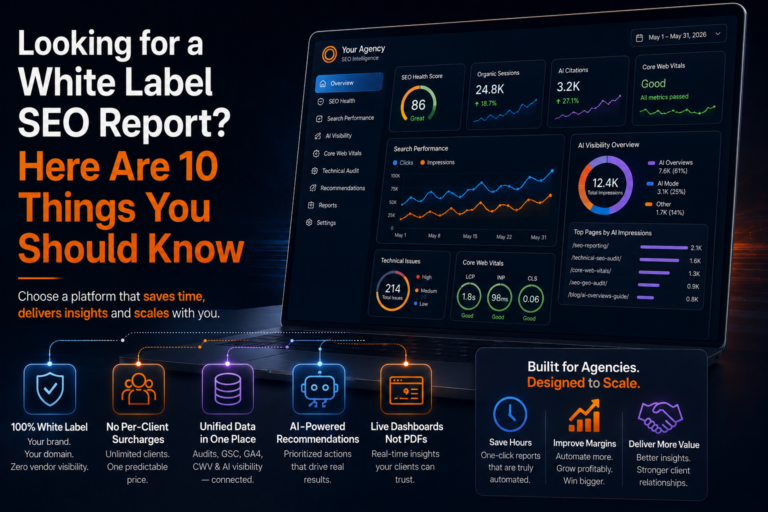
White Label SEO Reports: 10 Things Every Agency Should Know
Most agencies shopping for a white label SEO report focus on the wrong things. They compare pricing tiers,...
SEO Performance Trend Insights: What Long-Term Data Really Tells You About Growth
Most agencies review SEO performance month by month. However, SEO performance trends rarely follow a 30-day reporting cycle....
Ready to unify your agency's SEO stack?
Stop juggling 5+ tools for one report. Zensor brings SEO audits, GA4 analytics, GSC data, and AI search tracking into a single platform.