
AI SEO reporting is helping agencies solve a problem that has little to do with data collection and everything to do with decision-making.
Most SEO teams already have access to more data than they can realistically analyze. Between Google Analytics, Google Search Console, rank tracking platforms, technical audits, and client-specific dashboards, information is rarely the limitation.
The challenge is turning that information into insights quickly enough to support meaningful action.
As client expectations increase and reporting requirements become more complex, traditional reporting workflows are becoming harder to sustain. Manual exports, spreadsheet-heavy analysis, and repetitive reporting processes consume valuable time while limiting scalability.
This is where AI SEO reporting is changing how agencies and in-house teams operate. By automating repetitive work and accelerating insight discovery, AI allows teams to spend less time preparing reports and more time making decisions.
Why Traditional SEO Reporting Slows Teams Down
Most reporting processes were designed for a different era of SEO.
Monthly reports were created manually, performance data was pulled from multiple sources, and analysts spent hours combining metrics into client-friendly summaries.
That process becomes increasingly difficult as websites grow, reporting expectations rise, and agencies manage larger client portfolios.
Common reporting bottlenecks include:
- Manual data collection from multiple platforms
- Time-consuming report preparation
- Inconsistent reporting frameworks across clients
- Difficulty identifying meaningful insights quickly
- Limited visibility between reporting cycles
The issue is not that reporting takes time. The issue is that reporting effort often scales alongside client growth.
For agencies looking to grow sustainably, that model eventually becomes difficult to maintain.
Why Faster Reports Alone Don’t Create Value
Speed is often presented as the primary advantage of AI SEO reporting.
While faster reporting is valuable, speed by itself does not improve SEO performance.
A report delivered in five minutes instead of five hours is only useful if it helps teams understand what deserves attention.
The most effective reporting systems do more than accelerate workflows. They help SEO teams identify patterns, uncover opportunities, and prioritize actions.
This reflects a broader shift in the industry from reporting information to delivering insights that support decisions.
In other words, faster reporting matters because it enables faster action.
How AI SEO Reporting Helps Teams Find Insights Faster
One of the most important benefits of AI SEO reporting is its ability to process large volumes of data and surface meaningful patterns automatically.
Instead of manually reviewing dashboards and spreadsheets, teams can focus on understanding the signals that matter most.
For example, AI can help identify:
- Unexpected traffic declines
- Ranking shifts across key pages
- Changes in user behavior
- Technical issues affecting visibility
- Emerging growth opportunities
This reduces the amount of time spent searching for answers and allows teams to move more quickly toward investigation and action.
The objective is not to replace analysis. It is to make analysis more efficient.
Scaling Reporting Without Scaling Workload
Scalability is one of the biggest challenges facing agencies.
A reporting process that works well for five clients often becomes unsustainable when managing fifty.
Without automation, reporting effort tends to increase alongside the client portfolio.
AI SEO reporting helps break that relationship.
By automating data aggregation, monitoring, and initial analysis, agencies can support more clients without proportionally increasing reporting workload.
This creates a more scalable operating model while allowing teams to maintain reporting quality.
For agencies delivering white-label SEO reports, consistency and scalability are particularly important because reporting quality directly influences client experience.
Creating Consistency Across Clients and Campaigns
As SEO operations grow, maintaining consistency becomes increasingly difficult.
Different team members may interpret data differently, reporting structures may vary, and insight quality can fluctuate depending on who prepares the report.
AI SEO reporting helps establish a more standardized framework.
By applying consistent methodologies across reporting workflows, agencies can improve:
- Reporting accuracy
- Insight consistency
- Performance benchmarking
- Client communication
- Internal quality control
This consistency becomes a competitive advantage as organizations scale.
Moving From Reporting Data to Supporting Decisions
The strongest SEO reports do more than summarize performance.
They help stakeholders understand what happened, why it happened, and what should happen next.
AI SEO reporting supports this shift by helping teams move beyond raw metrics.
Instead of focusing exclusively on traffic, rankings, and clicks, reporting can become more focused on outcomes, priorities, and recommendations.
This aligns closely with the principles discussed in our guide to SEO reporting, where reporting becomes a tool for decision-making rather than simply a collection of metrics.
The value of reporting increases significantly when it helps teams determine where resources should be allocated.
Why Human Expertise Still Matters
AI can accelerate analysis, automate reporting tasks, and surface valuable insights.
What it cannot fully understand is business context.
An SEO recommendation that appears important in a report may not align with organizational priorities, development capacity, or commercial objectives.
This is why the most successful SEO teams combine AI-driven efficiency with human expertise.
Technology identifies patterns. People provide judgment.
AI supports better reporting, but strategy, prioritization, and communication still require experienced professionals.
For a broader perspective on this shift, explore our article on how AI is transforming SEO reporting for agencies.
The Future of AI SEO Reporting
SEO reporting is evolving rapidly.
Clients expect faster answers. Websites generate larger datasets. Decision-making cycles continue to accelerate.
As a result, reporting systems must become more efficient, more scalable, and more insight-driven.
AI SEO reporting is helping organizations meet those expectations by reducing manual effort and improving access to meaningful information.
The future of reporting will not be defined by bigger dashboards or more metrics.
It will be defined by the ability to deliver the right insights at the right time to support better decisions.
Conclusion
AI SEO reporting is not simply about speed.
Its real value lies in helping teams identify insights faster, maintain reporting quality at scale, and make better-informed decisions.
As reporting requirements continue to grow, agencies and in-house teams will increasingly rely on AI to manage complexity without sacrificing clarity.
The organizations that benefit most will be those that use AI to enhance expertise rather than replace it.
For additional guidance on measuring SEO performance, Google’s documentation on Google Analytics and Google Search Console provides useful resources for understanding modern search performance reporting.

Related Articles
Reporting to Revenue: How SEO Insights Drive Smarter Agency Growth Decisions
Revenue-driven SEO reporting should not end with rankings, traffic, or impressions. It should connect organic performance directly to...
SEO Performance Trend Insights: What Long-Term Data Really Tells You About Growth
Most agencies review SEO performance month by month. However, SEO performance trends rarely follow a 30-day reporting cycle....
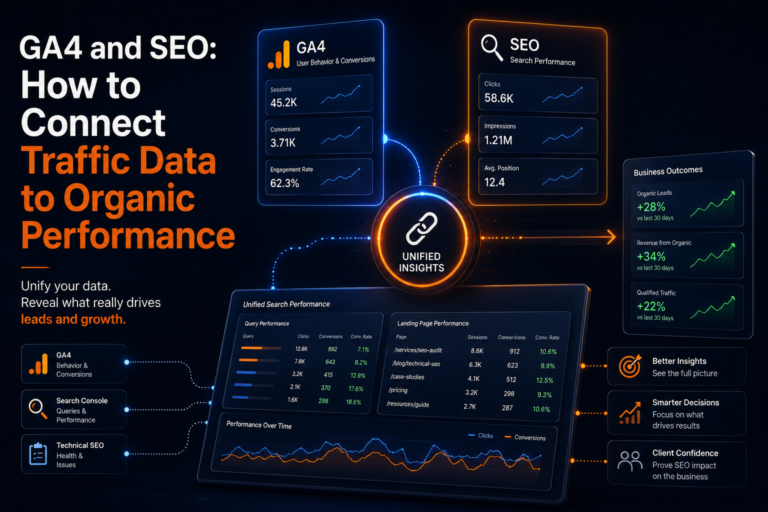
GA4 and SEO: How to Connect Traffic Data to Organic Performance
GA4 and SEO performance sit in separate dashboards for most agencies, and that separation is costing them clients....
Ready to unify your agency's SEO stack?
Stop juggling 5+ tools for one report. Zensor brings SEO audits, GA4 analytics, GSC data, and AI search tracking into a single platform.