
AI SEO Tools: 8 Ways Agencies Can Use Them Without Losing Strategic Control

AI SEO tools have a deployment problem. Agencies adopt them, output increases, and then something quietly breaks: the reports get longer, the recommendations multiply, and the client still asks what to fix first. The tools did not fail. The workflow did. Somewhere between “AI found 400 issues” and “here is what we are doing this month,” the strategic layer went missing.
In practice, AI SEO tools are genuinely useful when they remove repetitive analysis, surface patterns across large datasets, and help agencies move from data to action faster. However, they are not useful when they replace the judgment that connects a finding to a business outcome. The distinction sounds simple. In fact, it is the most important operational decision an agency makes when adopting these tools. In practice, most agency workflows blur it constantly.
Here are eight specific ways to use AI SEO tools without handing over strategic control — with the guardrails that keep each use case from becoming a liability.
1. Use AI SEO Tools to Find Patterns, Not Just Individual Errors
In practice, a traditional SEO audit produces a flat list of issues. Missing titles, broken links, redirect chains, duplicate content, slow templates. The list may be accurate — and entirely useless for prioritization.
AI SEO tools become valuable at the pattern layer. Suppose 400 product pages have missing meta descriptions. That is not 400 separate tasks. It is one template-level problem with 400 affected URLs. An AI-powered audit can group those pages, identify the likely source, and summarize the scale of the issue. However, the strategist still confirms the finding and works with the development team on the fix. The AI removes the counting. It does not replace the diagnosis.
That distinction matters because clients do not pay for error counts. They pay for an explanation of which structural problems are suppressing performance and what should happen next. One framing generates a ticket. The other generates trust.
2. Use AI for Issue Clustering Across Large Sites
In fact, issue clustering is one of the most practical uses of AI SEO tools for agencies managing multiple client websites. The objective is straightforward: turn thousands of disconnected findings into a smaller number of meaningful workstreams.
An AI tool can group issues by page type, URL pattern, CMS template, or technical relationship. It can also identify where several symptoms share a root cause. Indexation problems, missing canonical tags, and duplicate URLs may all trace back to a faceted navigation configuration. Treating them as separate tickets creates busy work. Treating them as one architectural problem creates a path to resolution.
Still, clustering is not proof. Review a sample of affected URLs manually. Confirm the HTML, response codes, crawl directives, and indexing status before presenting the cluster as a client recommendation. An AI that groups 300 pages as “canonicalization issues” is often correct. It is occasionally grouping symptoms of three different problems that happen to look similar in aggregate.
3. Use AI-Powered Recommendations to Prioritize Work
Most SEO recommendations fail before implementation begins. They arrive as a flat backlog where a minor image formatting issue sits beside a broken conversion page, both labeled “medium severity.” Developer time rarely materializes equally for both.
AI-powered SEO recommendations improve this by ranking issues against performance data and business context. Consequently, the flat backlog becomes a prioritized workstream. A useful prioritization model considers organic clicks and impressions, conversion value, page type, number of affected URLs, technical severity, and estimated implementation effort. A missing alt attribute on a low-value archive page may be valid. It is not urgent. A crawl-blocking directive on a high-converting service page is a different conversation entirely.
Consequently, the tool can surface that distinction. The strategist must validate it. Zensor’s AI-powered recommendations are designed to move agencies beyond issue discovery toward prioritized action. The useful output is not “here are 200 problems.” It is “these three problems deserve attention this month, and here is why.”
4. Use AI to Analyze Search Console Queries at Scale
Search Console contains more strategic evidence than most agencies extract from it. Query-level data reveals what users actually search for, which pages receive impressions without clicks, and where content is competing against itself for the same intent.
AI SEO tools can analyze queries at scale and group them into meaningful clusters — informational research, product comparison, transactional intent, local queries, support searches, branded traffic. That grouping, in turn, creates a useful starting point for identifying content gaps and potential cannibalization, where multiple pages compete for overlapping queries.
The mistake, however, is allowing the tool to generate a content calendar from this analysis without reviewing the actual search results. Query volume is data. Search intent is an interpretation. Business value is a strategic decision. Review the current results, competitor positioning, SERP features, and conversion history before recommending content investments. The AI provides the signal. However, the strategist provides the context that determines whether acting on that signal makes sense for this client.
5. Use AI to Turn Content Analysis Into Specific Editorial Decisions
Content analysis becomes useless when it ends with “improve quality” or “add more keywords.” Those are not recommendations. They are observations restated as instructions, and they produce no useful work.
The better use of AI is converting content signals into specific editorial decisions. For each page, a well-configured AI SEO tool can help identify the right editorial direction. Should the content be expanded because it covers the topic too narrowly? Refreshed because key information is outdated? Merged with another page that serves the same intent? Retired because it creates no meaningful value? The AI surfaces the signal. The strategist chooses the action.
These recommendations strengthen considerably when combined with Search Console impressions, organic clicks, GA4 engagement data, conversions, and technical health. Furthermore, do not publish AI-generated content simply because a tool identifies a gap. Confirm that the topic supports the client’s commercial goals and that the agency can add something genuinely useful. More pages are not automatically more visibility.
6. Use AI for Anomaly Detection Before the Client Notices
Monthly reporting is, by definition, retrospective. Anomaly detection is proactive. That distinction changes the agency-client relationship more than almost anything else in the reporting workflow.
Instead of explaining a traffic decline after it becomes visible, the agency can investigate unusual movement while there is still time to respond. AI can help detect meaningful changes across organic clicks and impressions, query groups and landing pages, conversion events, indexation and crawl health, page speed, Core Web Vitals, and AI search citation rates.
The important word, specifically, is meaningful. A small daily fluctuation is not an incident. A sudden decline across a high-value page group warrants investigation. Set sensible thresholds, compare against the correct date range, and check for seasonality, campaigns, site migrations, algorithm updates, and tracking changes before declaring a problem. Google recommends measuring Core Web Vitals using real-world field data rather than lab scores alone. The current metrics are LCP, INP, and CLS, measured at the 75th percentile across mobile and desktop users. See the official Web Vitals guidance for current thresholds.
Zensor combines Core Web Vitals monitoring with SEO performance data so agencies can investigate performance changes in the same environment rather than stitching together separate exports.
7. Use AI SEO Tools to Track AI Search Visibility — Carefully and Honestly
Traditional rank tracking is no longer a complete picture of search visibility. Clients may appear in Google’s AI Overviews, ChatGPT, or Perplexity regardless of their keyword positions. AI SEO tools can help agencies monitor these surfaces and identify where a brand is mentioned, cited, or absent.
That said, the guardrail here is important. Google states that AI Overviews and AI Mode rely on foundational SEO requirements — pages must be indexed and eligible to appear in standard search results. Google also confirms there are no additional technical requirements specifically for appearing in these AI features. However, that does not make AI visibility tracking irrelevant. It means agencies should avoid inventing unsupported rules about what causes or prevents AI citations.
Instead, track visibility across a consistent set of commercial and informational prompts. Record the platform, date, query, cited pages, competitors cited, and changes over time. Then compare those findings against organic performance, content coverage, authority signals, and technical health. The AEO and GEO audit layer makes this comparison possible without managing it across separate tools. The responsible conclusion from that data is “visibility changed under these conditions.” The irresponsible conclusion is “add this phrase and you will be cited.”
8. Use AI to Draft Client Communication — Then Make a Human Own It
AI can summarize complex datasets quickly. That is useful. It can also produce confident explanations that are incomplete or factually wrong. That is dangerous, particularly in a client-facing context where a misattributed cause or an overstated projection damages the relationship directly.
Let AI draft the narrative — executive summaries, issue explanations, page-level recommendations, period comparisons, developer action lists. Then require a strategist to review every important claim before it reaches the client. Confirm the source data, date range, affected URLs, expected impact, and recommended owner. A client does not need a longer report. They need a defensible explanation of what changed, why it matters, and what happens next.
That is the difference between automated reporting and useful communication. One produces output. The other, consequently, produces decisions.
The Principle Behind All Eight AI SEO Tool Use Cases
The correct agency SEO workflow is not human versus AI. It is human judgment supported by AI systems. Specifically, AI SEO tools are good at processing large datasets, finding recurring patterns, grouping related issues, detecting unusual movement, drafting summaries, and reducing repetitive reporting work. Experienced SEO professionals remain responsible for confirming findings, connecting them to business outcomes, assessing search intent, choosing the right strategic response, managing implementation risk, and explaining uncertainty to the client.
Google’s own guidance continues to emphasize helpful, reliable, people-first content and established SEO fundamentals. As discussed in our guide to why SEO recommendations die in the development backlog, the gap between identifying an issue and acting on it is almost always a prioritization and communication failure — not a data failure. AI closes the data gap. It does not close the other one.
In short, the false promise is that an AI SEO tool can run the entire strategy. The real opportunity is narrower and more valuable: remove the busy work so the team can spend more time on the execution and judgment that actually moves the needle.
What to Look for in an AI SEO Tool for Agency Work
Notably, the agencies getting the most from AI SEO tools are not the ones using the most tools. They are the ones that have consolidated the data sources those tools produce into a single environment where patterns are visible across audits, search performance, traffic, and AI visibility simultaneously.
Furthermore, if your agency is still combining separate crawlers, Search Console exports, GA4 dashboards, Core Web Vitals monitors, and AI visibility checks manually, the bottleneck is not any individual tool. It is the assembly step between them — the hours spent aligning date ranges, matching URLs across exports, and building a coherent picture from five separate data models.
Zensor unifies the entire SEO workflow into one platform. Automated technical SEO audits, Search Console performance, GA4 traffic, Core Web Vitals monitoring, and AEO/GEO visibility tracking — all in one dashboard, all feeding the same AI-powered recommendation layer. The result is not another dashboard. It is fewer disconnected systems and more time for the work that produces results.
Try Zensor free — one website, full platform access, no credit card required.
Related Articles

Leveraging AI for Deeper Technical SEO Insights
AI technical SEO insights are helping agencies and SEO teams move beyond surface-level audits and understand what actually...

Using AI for Efficient Client Reporting in SEO
Using AI for Efficient Client Reporting in SEO Client reporting has always been a critical part of SEO...
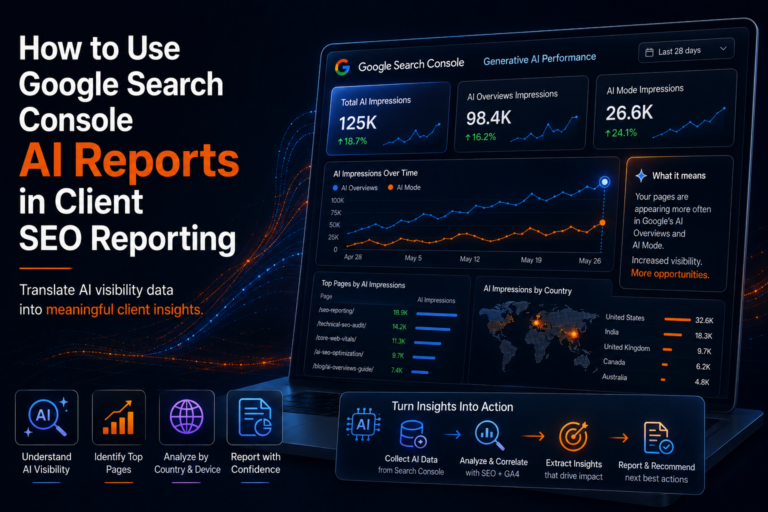
How to Use Google Search Console AI Reports in Client SEO Reporting
Google Search Console now includes a dedicated generative AI performance report for eligible properties. It shows how often...
Ready to unify your agency's SEO stack?
Stop juggling 5+ tools for one report. Zensor brings SEO audits, GA4 analytics, GSC data, and AI search tracking into a single platform.