

At the enterprise level, SEO reporting exists to support decisions. Not to document activity. Not to educate stakeholders on SEO mechanics. And not to justify work already completed.
However, most SEO reports still fail because their structure forces leadership teams to interpret performance instead of acting on it. High-performing agencies take a different approach. They design SEO reporting as a decision framework, not a performance archive.
Why Traditional SEO Reporting Breaks Down at Scale
As organizations grow, complexity increases:
- Multiple stakeholders with competing priorities
- Longer approval and execution cycles
- Higher cost of misaligned decisions
SEO reports built around raw metrics, tool-based sections, or long issue lists push the burden of interpretation onto leadership.
At scale, this interpretation gap is where momentum is lost.
The Structural Shift: From Activity Reporting to Decision Enablement
Average agencies focus their SEO reporting on activity:
- Traffic increased or declined
- Rankings moved
- Issues were identified
High-performing agencies focus on implications.
Their SEO reports are structured around four executive questions:
- What materially changed?
- Why did it change?
- What does this signal for growth or risk?
- What decision does this require?
If a metric does not help answer one of these questions, it should not lead the narrative.
Lead With Interpretation, Not an Executive Summary
Enterprise stakeholders do not need condensed dashboards. They need a point of view.
The opening section of an effective SEO reporting framework establishes:
- The current direction of organic performance
- The most significant factor influencing that direction
- Whether the change is temporary or structural
This is interpretation, not summarization.
A leadership reader should understand the state of SEO in under two minutes without reviewing a single chart.
Organize SEO Reports by Business Impact, Not by Data Source
Tool-based SEO reporting structures do not scale in enterprise environments.
High-performing agencies organize reports around business impact areas such as:
- Demand capture and organic visibility
- Content effectiveness and search intent alignment
- Technical constraints limiting performance at scale
- Influence on conversion, pipeline, or revenue
Analytics platforms and audits become supporting evidence, not report sections.
This approach allows stakeholders to assess SEO performance without needing to understand how individual tools work.
Focus on Trends That Indicate Direction
Month-on-month SEO reporting encourages reactive decision-making.
In contrast, high-performing agencies emphasize:
- Multi-month performance trends
- Pattern consistency or degradation
- Structural signals that require intervention
While volatility is acknowledged, it is not allowed to dictate strategy.
This matters because enterprise execution cycles are long, and frequent course corrections are expensive.
Recommendations Must Be Causally Defensible
At the enterprise level, SEO recommendations compete for limited resources.
For that reason, high-performing agencies do not prescribe actions without establishing causality.
Each recommendation is clearly tied to:
- A diagnosed root cause
- The expected mechanism of impact
- The risk or opportunity cost of inaction
This framing turns SEO recommendations into strategic choices instead of tactical suggestions.
Force Prioritization to Enable Execution
Unprioritized recommendations delay execution.
High-performing agencies treat prioritization as a strategic responsibility, not a courtesy.
This includes:
- Ranking actions by expected business impact
- Making trade-offs explicit
- Aligning priorities with enterprise goals, not SEO convenience
Leadership teams do not need more options. They need clarity.
Embed Accountability Into the SEO Reporting Structure
Execution improves when ownership is visible.
High-performing SEO reporting explicitly defines:
- Who owns each action
- What success looks like
- When impact will be reviewed
This transforms SEO reporting from a recurring deliverable into an operational feedback loop.
Why This Approach Earns Executive Trust
Decision-oriented SEO reporting aligns with how enterprise leadership operates:
- Clarity over completeness
- Direction over diagnostics
- Accountability over activity
This philosophy reflects a broader shift in how modern organizations approach SEO reporting — moving from static performance documentation to insight-led, decision-driven systems.
SEO Reporting Is an Enterprise Capability
High-performing agencies treat SEO reporting as a strategic capability.
- Designed intentionally
- Refined continuously
- Measured by decisions and outcomes, not report length
If enterprise stakeholders are not acting on SEO reports, the failure is structural.
Reporting that drives action is not about better charts. It is about better design.

Related Articles
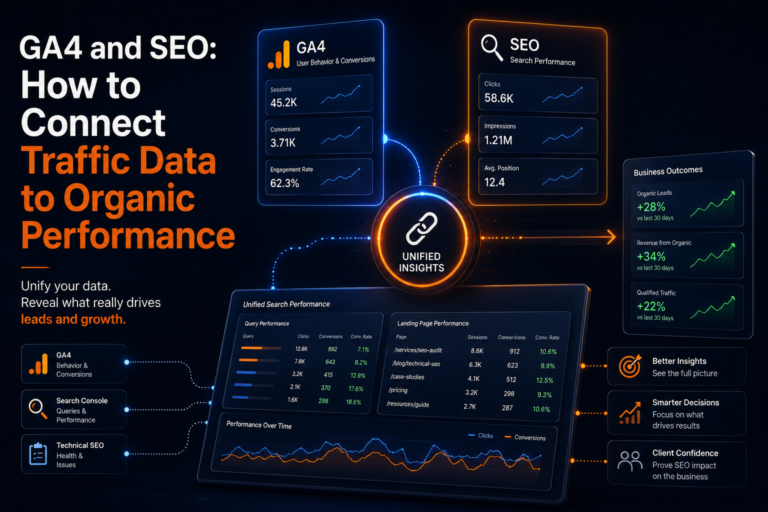
GA4 and SEO: How to Connect Traffic Data to Organic Performance
GA4 and SEO performance sit in separate dashboards for most agencies, and that separation is costing them clients....

AI-Powered SEO Reporting Platforms for Agencies: What to Look For
AI SEO reporting platforms are becoming standard in modern agencies. Nearly every vendor promises automation, intelligence, and strategic...
SEO Performance Trend Insights: What Long-Term Data Really Tells You About Growth
Most agencies review SEO performance month by month. However, SEO performance trends rarely follow a 30-day reporting cycle....
Ready to unify your agency's SEO stack?
Stop juggling 5+ tools for one report. Zensor brings SEO audits, GA4 analytics, GSC data, and AI search tracking into a single platform.