SEO has always rewarded those who act early. But as competition intensifies and search ecosystems become more volatile, reacting to performance drops is no longer enough.
For modern agencies, success increasingly depends on the ability to anticipate change, forecast outcomes, and guide clients proactively — not after traffic or revenue has already declined.
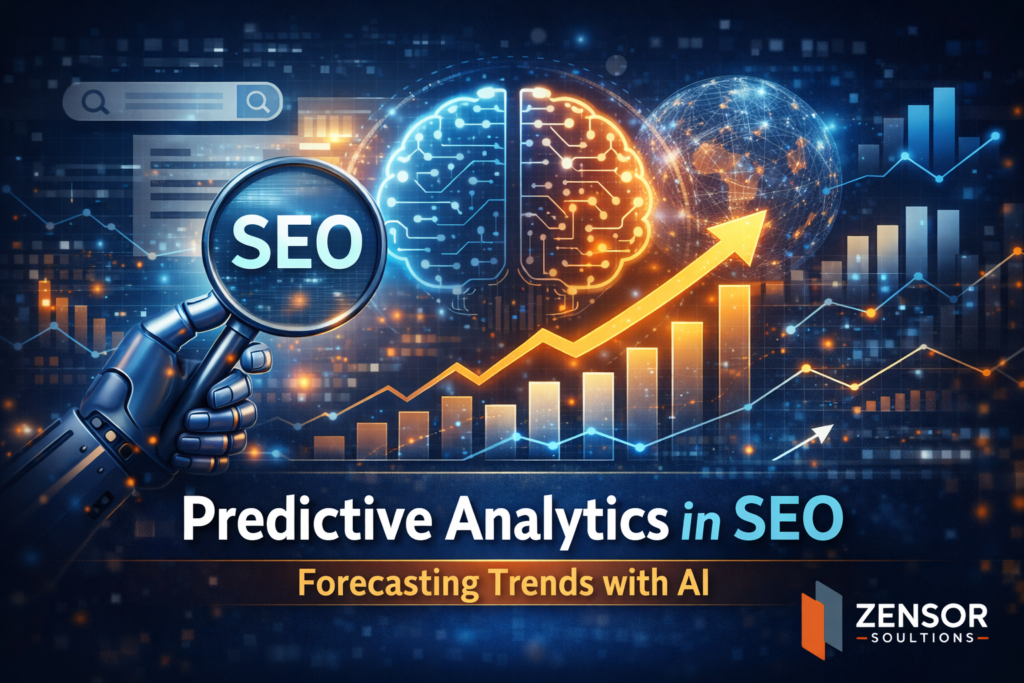
This is where predictive analytics powered by AI is redefining SEO strategy.
Instead of relying on backward-looking reports, predictive SEO enables agencies to forecast trends, identify risks before they surface, and align SEO efforts with future business outcomes. For agencies managing multiple clients, markets, and stakeholders, this shift is quickly becoming a commercial necessity — not a technical upgrade.
The Shift from Descriptive to Predictive SEO
Traditional SEO reporting focuses on explaining the past:
- What happened to rankings last month?
- Which pages lost traffic?
- Why did conversions decline?
While this information is useful, it does little to answer the question clients increasingly care about:
“What happens next — and what should we do now?”
Predictive SEO analytics addresses this gap by using AI to forecast outcomes based on historical patterns, real-time signals, and market dynamics.
This evolution builds directly on the role AI already plays in uncovering deeper performance and technical insights, as discussed in our article on
leveraging AI for deeper technical SEO insights.
Instead of reacting to performance changes, agencies can:
- Anticipate ranking volatility before it impacts traffic
- Identify emerging keyword and content opportunities early
- Proactively guide clients with data-backed recommendations
This shift moves SEO from an operational function to a strategic advisory service — increasing perceived value and strengthening long-term client relationships.
How AI Forecasts SEO Trends
AI-driven predictive analytics works by analyzing large, interconnected datasets that are impossible to evaluate manually at scale. Rankings, crawl data, SERP behavior, seasonality, competitor movement, and historical performance are evaluated simultaneously to detect meaningful patterns.
1. Keyword and Demand Forecasting
AI models assess historical search behavior, ranking stability, SERP features, and competitor shifts to forecast which keywords are likely to gain or lose traction.
For agencies, this enables:
- Early identification of growth opportunities
- Smarter prioritization of content and optimization efforts
- Reduced time spent chasing low-impact keywords
2. Traffic and Performance Projections
By combining ranking trends with click-through behavior and historical traffic patterns, AI can model likely performance scenarios.
This allows agencies to:
- Set realistic performance expectations with clients
- Support SEO roadmaps with forward-looking data
- Justify proactive investments before performance declines
3. Early Risk Detection
Predictive analytics can surface warning signals such as abnormal ranking volatility, crawl inefficiencies, or SERP shifts that often precede broader performance impact.
These capabilities are significantly amplified when SEO data is unified across tools and sources — a challenge addressed in our guide on
integrating AI tools for unified SEO analytics.
Why Predictive SEO Is a Commercial Advantage for Agencies
Predictive analytics is not just about better insights — it directly impacts how agencies grow and protect revenue.
Protecting Retainers Through Proactive Strategy
Agencies lose clients when SEO feels reactive or unpredictable. Predictive insights allow teams to lead conversations with confidence, positioning SEO as a controlled, strategic investment rather than an uncertain expense.
When agencies can explain what is likely to happen — and why — client trust increases.
Unlocking Higher-Value Advisory Engagements
Predictive SEO naturally elevates agencies from execution partners to strategic advisors.
Instead of reporting on past metrics, agencies can:
- Present forward-looking insights in quarterly reviews
- Align SEO recommendations with revenue planning
- Justify premium retainers and strategic upsells
The Reality: Predictive SEO Does Not Scale Manually
While the benefits of predictive analytics are clear, most agencies struggle to operationalize it.
Common challenges include:
- SEO data scattered across disconnected tools
- Manual analysis that does not scale across clients
- Inconsistent forecasting approaches
- Difficulty translating predictions into client-ready insights
Without a unified intelligence layer, predictive SEO becomes theoretical rather than actionable.
How Zensor Solutions Enables Predictive SEO at Scale
Zensor Solutions is purpose-built to help agencies move from reactive reporting to predictive intelligence — without adding operational overhead.
By unifying technical SEO data, performance metrics, and historical trends into a single AI-driven platform, Zensor Solutions enables agencies to:
- Forecast SEO performance across multiple clients consistently
- Identify opportunities and risks early
- Reduce time spent on manual analysis
- Deliver clear, forward-looking insights clients can act on
Instead of stitching together insights from multiple tools, agencies gain a centralized system that supports strategic decision-making at scale.
The Future of SEO Is Predictive — and Clients Will Expect It
As search becomes more competitive and volatile, explaining the past will no longer be enough. Clients will expect agencies to anticipate change, guide decisions, and protect growth.
Predictive analytics does not replace SEO expertise — it amplifies it.
Agencies that embrace AI-powered forecasting will not only deliver better outcomes, but also strengthen client trust, increase retention, and differentiate themselves in an increasingly crowded market.
The question is no longer whether predictive SEO will matter — but which agencies will lead with it.
Explore more insights on SEO reporting and analytics → SEO Metrics, Analytics & Tactical Reporting