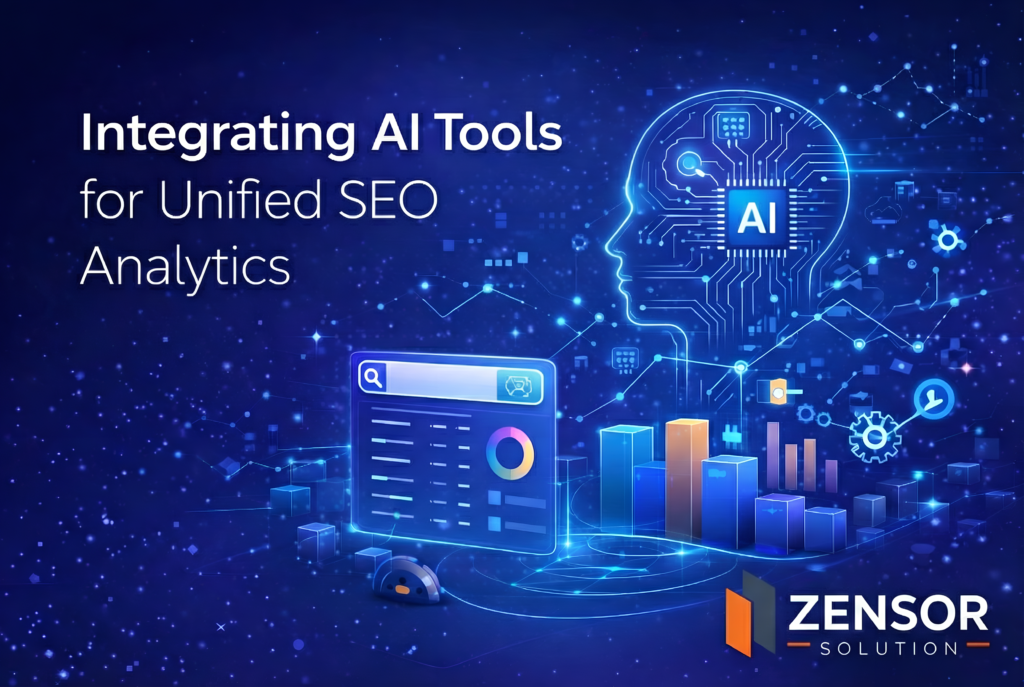
Unified SEO analytics has become a necessity for modern SEO teams that are overwhelmed by data but lacking clarity.
Between Search Console, analytics platforms, crawling tools, backlink trackers, page speed reports, and content performance dashboards, critical insights are scattered across systems that don’t naturally speak to each other.
The real SEO bottleneck today isn’t data collection. It’s integration.
This is where AI-powered unified SEO analytics is reshaping how agencies and in-house teams operate. By connecting multiple SEO tools into a single intelligence layer, AI enables teams to move beyond fragmented metrics and toward faster, more confident decision-making.
The Problem with Fragmented SEO Tool Stacks
Most SEO teams didn’t design their tool stack—it evolved over time.
Each platform solves a specific problem, but together they introduce daily operational friction:
- Account managers chasing data before client calls
- SEO leads reconciling conflicting metrics across tools
- Manual exports, screenshots, and spreadsheet cleanups
- Insights arriving too late to influence strategy
As SEO strategies grow more sophisticated, fragmentation doesn’t just slow teams down—it actively limits strategic visibility. This becomes even more apparent when scaling technical workflows, a challenge explored in leveraging AI for deeper technical SEO insights.
What Unified SEO Analytics Really Means
Unified SEO analytics is often misunderstood.
It’s not about replacing your existing tools, and it’s not about building yet another dashboard.
True unification connects SEO, content, and performance data into a single, consistent view—where AI normalizes metrics, identifies relationships, and surfaces insights that are otherwise buried across platforms.
The outcome is not more charts, but clearer intelligence. This shift reflects how leading teams are moving toward creating actionable insights with AI-based analytics instead of relying on static reporting.
How AI Enables Seamless SEO Tool Integration
Traditionally, integration required rigid connectors and ongoing manual maintenance. AI fundamentally changes this dynamic.
AI-powered systems can:
- Automatically align inconsistent metrics across tools
- Correlate technical issues with traffic and ranking changes
- Identify patterns across content, backlinks, and performance
- Adapt as APIs, datasets, and tools evolve
This reduces the hidden coordination cost of SEO operations and allows teams to focus on insight-driven actions—especially when combined with automated SEO audits that save time while increasing depth.
From Data Aggregation to Decision Intelligence
Not all unified analytics systems are equal.
Many stop at aggregation. AI-driven platforms go further by interpreting data in context.
- Technical crawl errors can be directly tied to visibility losses
- Content performance can be evaluated alongside site health
- Backlink trends can be assessed in relation to keyword movement
This intelligence-first approach also improves how insights are communicated, as discussed in turning SEO data into action through AI-generated client-friendly reports.
A Simple Maturity Lens for SEO Analytics
From an operational standpoint, most SEO teams fall into one of four stages:
- Tool Collection: Multiple platforms operating independently
- Data Aggregation: Centralized dashboards with limited context
- Insight Correlation: AI connecting signals across datasets
- Decision Intelligence: Insights directly informing strategy
Unified SEO analytics powered by AI enables teams to move up this maturity curve without increasing manual effort.
Benefits of Unified AI-Driven SEO Analytics
Faster, More Confident Decisions
Unified insights eliminate guesswork and reduce reaction time when issues or opportunities emerge.
Better Strategic Alignment
Technical SEO, content, and performance teams work from the same source of truth, reducing internal friction.
Scalable Agency Operations
Agencies can manage more clients without multiplying reporting complexity, especially when paired with AI-driven SEO reporting built for scale.
Clearer Client Communication
Unified analytics shifts client conversations from metrics to outcomes, trends, and next steps.
Common Pitfalls to Avoid
- Integrating tools without defining decision goals
- Overloading dashboards with low-impact metrics
- Treating integration as a one-time setup
The objective isn’t to connect everything—it’s to connect what matters.
The Future of SEO Analytics Is Unified
As search ecosystems grow more complex, fragmented analytics will increasingly hold teams back.
Unified SEO analytics powered by AI represents a more mature approach—where data is not just collected, but understood and applied.
By integrating AI tools into a cohesive analytics framework, SEO professionals can shift their focus from managing systems to driving measurable growth.
Explore more insights on SEO tools and automation → SEO Tools & Automation