Most SEO reports don’t fail because they lack data, they fail because they don’t help anyone decide what to do next.
This is why many SEO reports feel complete but still fail to drive action — they describe performance without guiding decisions.
That’s the problem with most reporting frameworks. Even when they’re well-structured, they tend to focus on organizing information rather than guiding action.
And in practice, more organized data doesn’t always lead to better decisions — it often just makes reports look more complete than they actually are.
This is where a unified SEO reporting framework becomes valuable. Not because it brings everything into one place, but because it connects performance, visibility, and underlying causes in a way that actually supports decision-making.
The Fragmentation Problem a Unified SEO Reporting Framework Solves
Traditional reporting workflows are typically organized around tools instead of decisions. Consequently, each dataset answers a different question but rarely connects to a shared narrative.
- Analytics explains what happened.
- Search Console shows how visibility shifted.
- Technical audits highlight site-level issues.
Individually, each layer provides value. Collectively, without interpretation, they generate noise inside reporting decks.
Metrics Without Context
A traffic decline appears in analytics. Meanwhile, impressions remain stable in Search Console. In parallel, an audit flags dozens of technical warnings.
Which signal matters most? More importantly, which one drives business impact?
Without structured synthesis, reporting fails to answer causation — and recommendations lack strategic conviction.
Tactical Updates Instead of Strategic Direction
Many reports focus on month-over-month comparisons and surface-level changes. However, clients invest in SEO for predictable growth, not isolated activity summaries.
Therefore, a reporting structure must move beyond updates and toward diagnosis.
What Defines a Unified SEO Reporting Framework?
A unified SEO reporting framework connects three integrated layers into one coherent decision model:
- Outcome Layer – Revenue, leads, and conversion performance.
- Visibility Layer – Impressions, CTR trends, and query intent movement.
- Causal Layer – Technical, architectural, and structural enablers.
Most reporting frameworks stop at organizing data across these layers. But organization alone doesn’t create clarity — it often just creates the illusion of understanding.
Instead of organizing insights tool by tool, this structure aligns data around business movement. As a result, reporting becomes an executive communication system rather than a dashboard export.
This strategic structure builds upon our reporting methodology by reinforcing interpretation over aggregation.
From Reporting to Decisions: How to Actually Use This Framework
Most SEO reporting frameworks explain how to structure data.
Very few explain how to use that structure to make decisions.
This is where most reports fail — not in what they show, but in what they enable.
Here’s how to turn this unified reporting framework into actual decisions:
Step 1: Identify the Signal
Start by identifying what has changed — without jumping to conclusions.
- Has traffic dropped?
- Are impressions declining?
- Are rankings stable but conversions falling?
At this stage, the goal is clarity, not interpretation.
Step 2: Understand What It Means
Now connect the signal to the right layer:
- If impressions are down → the issue likely sits in visibility (indexing, rankings, crawlability)
- If traffic is down but impressions are stable → this is often a click-through or intent alignment issue
- If conversions drop while traffic remains stable → the problem may lie beyond SEO (UX, messaging, or targeting)
This is where reporting moves from data to insight.
For example, if a client sees a 20% drop in organic traffic while impressions remain stable, the instinct is often to investigate rankings. But in many cases, this points to a click-through or intent alignment issue rather than a visibility problem.
Without this distinction, teams end up fixing the wrong layer — and reporting fails to drive meaningful outcomes.
Step 3: Evaluate Impact Before Acting
Not every issue deserves attention.
Before taking action, ask:
- Does this impact revenue or just surface-level metrics?
- How widespread is the issue?
- Is this a temporary fluctuation or a structural problem?
This prevents teams from reacting to noise.
Step 4: Decide What to Do Next
Every report should lead to one of four outcomes:
- Act immediately (high impact, clear cause)
- Schedule for later (high impact, complex fix)
- Monitor (uncertain or emerging signal)
- Ignore (low impact or irrelevant)
Without this step, reporting remains descriptive — not actionable.
Step 5: Decide What NOT to Do
This is where mature reporting stands apart.
Avoid:
- Fixing issues that don’t affect visibility or revenue
- Over-optimizing pages with no business value
- Reacting to short-term fluctuations without trend validation
Good reporting doesn’t just tell you what to fix — it protects you from fixing the wrong things.
A unified SEO reporting framework is not valuable because it organizes data.
It’s valuable because it helps you decide what matters — and what doesn’t.
How to Structure a Unified SEO Reporting Framework
High-performing agencies organize reporting around decisions, not software platforms. Consequently, each section of the report supports a clear cause-and-effect explanation.
1. Begin With Business Movement
- Revenue trends
- Organic contribution to pipeline
- Conversion rate changes
This establishes executive relevance immediately.
2. Diagnose Visibility Shifts
- Impression growth or decline
- High-intent query volatility
- CTR changes across key landing pages
More importantly, visibility signals often shift before revenue movement becomes obvious in analytics dashboards.
3. Interpret Behavioral Signals
- Landing page engagement metrics
- Funnel drop-offs
- Intent alignment gaps
In contrast to surface-level traffic analysis, behavioral interpretation explains whether ranking gains translate into qualified performance.
4. Add Technical Context
- Indexation inefficiencies
- Internal linking dilution
- Core Web Vitals constraints
In addition, structural limitations can quietly suppress performance long before traffic drops become visible.
5. Conclude With a Decision Framework
- Primary growth hypothesis
- Confidence level
- Recommended prioritization
- Expected impact window
Ultimately, this final section transforms reporting into a strategic advisory instrument.
A Practical Comparison: Fragmented vs Structured Reporting
Fragmented reporting:
- Traffic down 10%
- Impressions stable
- New crawl warnings detected
Conclusion: Continue monitoring.
Unified framework approach:
- Revenue decline tied to reduced non-brand conversions.
- Search Console reveals CTR erosion on high-intent keywords.
- Technical review identifies weakened internal link equity to commercial pages.
Therefore, prioritizing internal linking restoration and snippet optimization becomes a focused recovery strategy rather than a general observation.
Why Every Agency Needs a Unified SEO Reporting Framework
As automation accelerates data availability, raw metrics are becoming easier to generate. For example, platforms such as Google Search Console continue expanding visibility reporting capabilities.
However, access to data does not guarantee clarity.
Agencies that integrate outcome, visibility, and technical layers into one structured narrative gain:
- Stronger executive trust
- Clearer prioritization
- Faster strategic alignment
- Defensible long-term recommendations
In contrast, fragmented reporting reduces confidence and slows decision-making.
Conclusion
A good SEO report doesn’t just explain performance. It reduces uncertainty.
It helps teams understand what matters, what doesn’t, and what to do next.
Because in most cases, that’s what clients are actually paying for — not more data, but clearer decisions.

Related Articles
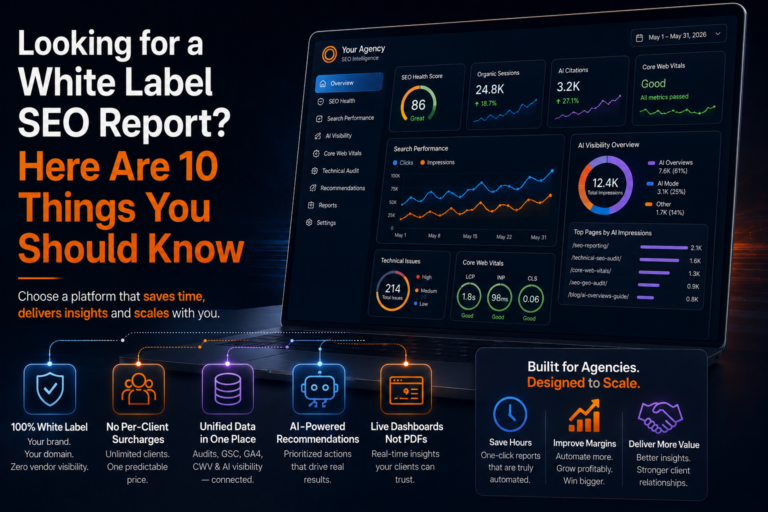
White Label SEO Reports: 10 Things Every Agency Should Know
Most agencies shopping for a white label SEO report focus on the wrong things. They compare pricing tiers,...

How AI is Transforming SEO Reporting for Agencies
AI-powered SEO reporting is changing how agencies manage one of the most time-consuming parts of their workflow. As...

AI-Powered SEO Reporting Platforms for Agencies: What to Look For
AI SEO reporting platforms are becoming standard in modern agencies. Nearly every vendor promises automation, intelligence, and strategic...
Ready to unify your agency's SEO stack?
Stop juggling 5+ tools for one report. Zensor brings SEO audits, GA4 analytics, GSC data, and AI search tracking into a single platform.