

By 2026, agencies without a structured SEO reporting roadmap will struggle to defend their strategic relevance.
The future of SEO reporting is not about better dashboards. Instead, it is about building a structured reporting architecture that connects data, diagnostics, prioritization, and forecasting into a single decision-making system.
As we explained in our foundational guide on modern SEO reporting frameworks, the shift from reporting data to driving decisions is already underway. However, the roadmap model takes this transformation further by structuring reporting into an operational intelligence system.
In the coming years, reporting will no longer be judged by how well it summarizes performance. Rather, it will be judged by how clearly it guides direction.
Why Every Agency Needs an SEO Reporting Roadmap in 2026
For years, agencies have reported on rankings, traffic, and conversions as proof of performance. While these metrics still matter, they no longer answer the most important business questions.
By 2026, clients will expect agencies to explain:
- Why performance changed — not just that it changed
- Which structural factors are influencing growth
- What should be prioritized next — and why
- What revenue impact current SEO momentum can realistically produce
Traditional reporting frameworks summarize activity. In contrast, a mature SEO reporting roadmap connects performance directly to business outcomes.
What an SEO Reporting Roadmap Actually Defines
An SEO reporting roadmap is not a static document created at the start of a retainer. Rather, it is an evolving framework that defines how insights are generated, structured, and translated into decisions.
This evolution aligns closely with building a unified SEO data narrative across GA, GSC, and technical audits, where data sources no longer operate in isolation.
By 2026, high-performing agencies will structure their reporting systems across four interconnected layers.
1. Performance Intelligence Layer
First, this layer moves beyond isolated metrics. It tracks long-term trends, detects anomalies, and interprets multi-quarter performance patterns. AI-assisted systems surface deviations before they become visible in static dashboards.
2. Diagnostic Layer
Second, traffic shifts are connected to root causes. Technical SEO changes, content velocity adjustments, indexation patterns, and internal linking architecture are mapped directly to performance movement.
This structured diagnostic thinking aligns with root cause analysis in SEO, where surface-level fluctuations are traced back to systemic drivers.
As a result, reporting shifts from “what happened” to “why it happened.”
3. Prioritization Layer
Third, instead of generic issue lists, the roadmap-driven reporting system translates insights into ranked initiatives based on projected business impact. Each action item is evaluated against opportunity size, implementation complexity, and expected ROI.
4. Forecast & Scenario Layer
Finally, this layer integrates predictive modeling. Agencies simulate potential growth scenarios based on technical debt reduction, content expansion, or authority-building efforts.
Therefore, forecasting does not replace strategy. It strengthens it.
How AI Restructures Reporting Frameworks
AI does not eliminate reporting. Instead, it reorganizes it.
Until recently, reporting involved manually stitching together data from Google Analytics, Search Console, and technical audit tools. According to guidance from Google Search Central, sustainable SEO performance depends on technical health, structured content, and measurable user signals — elements that require integrated visibility.
AI-driven systems now identify pattern-level relationships across datasets. Consequently, reporting becomes intelligence-driven rather than compilation-based.
Automated Insight Extraction
AI surfaces correlations across ranking volatility, crawl inefficiencies, and conversion shifts at a scale that manual analysis cannot match.
Root Cause Mapping at Scale
Rather than listing hundreds of technical issues, modern systems cluster issues into causal themes — such as indexation fragmentation, content decay, or structural crawl dilution. Thus, reporting becomes diagnosis rather than enumeration.
Forward-Looking Modeling
By layering historical performance data with implementation velocity, AI systems simulate likely outcomes. For example, agencies can estimate how resolving technical bottlenecks may influence organic growth across two quarters.
By 2026, predictive framing will be expected within every mature reporting roadmap.
The Strategic Implications of Structured Reporting
For agency founders and directors, the evolution of roadmap-driven reporting is not merely operational. Instead, it is commercial.
- Client retention stability improves
- Pricing power strengthens
- Expansion revenue becomes easier to justify
- Strategic authority increases
Agencies that continue presenting static reports risk being viewed as tactical vendors. In contrast, agencies that implement structured reporting architecture position themselves as growth architects.
In other words, reporting infrastructure becomes a competitive moat.
The Operational Shift for SEO Teams
For SEO leads and reporting managers, the roadmap model changes daily workflows.
Instead of manually preparing monthly decks, teams must operate structured systems that continuously integrate performance data, diagnostics, and implementation tracking.
This shift connects directly to how high-performing agencies structure reports that clients act on, as explored in our guide on agency SEO reporting structures.
Ultimately, reporting becomes a living operational backbone rather than a monthly deliverable.
From Tools to Infrastructure
One of the most important shifts agencies will face by 2026 is the move from disconnected tools to structured reporting infrastructure.
A mature reporting ecosystem requires integration — not fragmentation. Without systemic cohesion, even advanced tools fail to create clarity.
Infrastructure-level thinking ensures that AI insights are accountable, traceable, and connected to decision loops.
What Agencies Should Build Now
- Audit current reporting against business impact questions
- Define a standardized roadmap template
- Integrate cross-source data into unified dashboards
- Introduce predictive scenario discussions into quarterly reviews
- Align reporting cadence with implementation velocity
Importantly, this is not about adding more metrics. Rather, it is about engineering structured clarity.
The Future Standard of SEO Reporting
The future of SEO reporting is roadmap-driven, AI-enabled, and decision-focused.
By 2026, agencies will not be differentiated by how well they visualize data. Instead, they will be differentiated by how effectively they translate intelligence into accountable direction.
The agencies that understand this structural shift early will not just adapt to the future of reporting — they will define it.

Related Articles

SEO Performance Trend Insights: What Long-Term Data Really Tells You About Growth
Most agencies review SEO performance month by month. However, SEO performance trends rarely follow a 30-day reporting cycle....

Why Agencies Use Automated Technical SEO Reports
If you’re managing SEO for multiple clients, technical reporting can quickly become one of the most time-consuming parts...
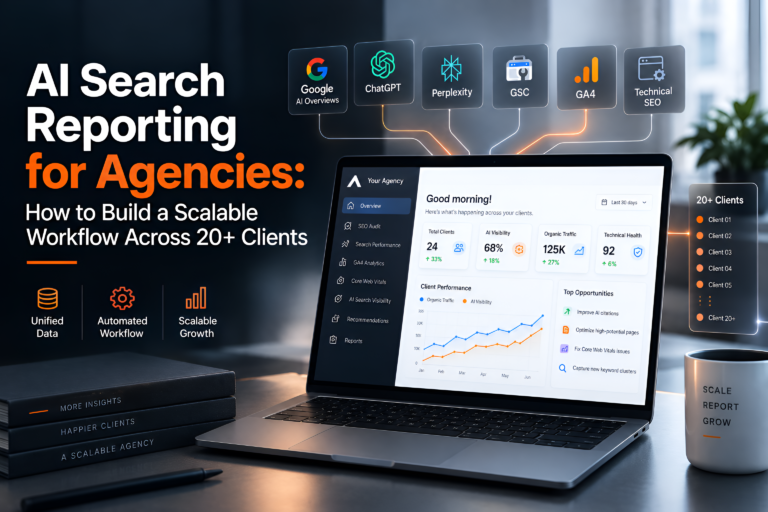
AI Search Reporting for Agencies: How to Build a Scalable Workflow Across 20+ Clients
Most agencies do not have an AI search reporting problem because they lack access to data. They have...
Ready to unify your agency's SEO stack?
Stop juggling 5+ tools for one report. Zensor brings SEO audits, GA4 analytics, GSC data, and AI search tracking into a single platform.